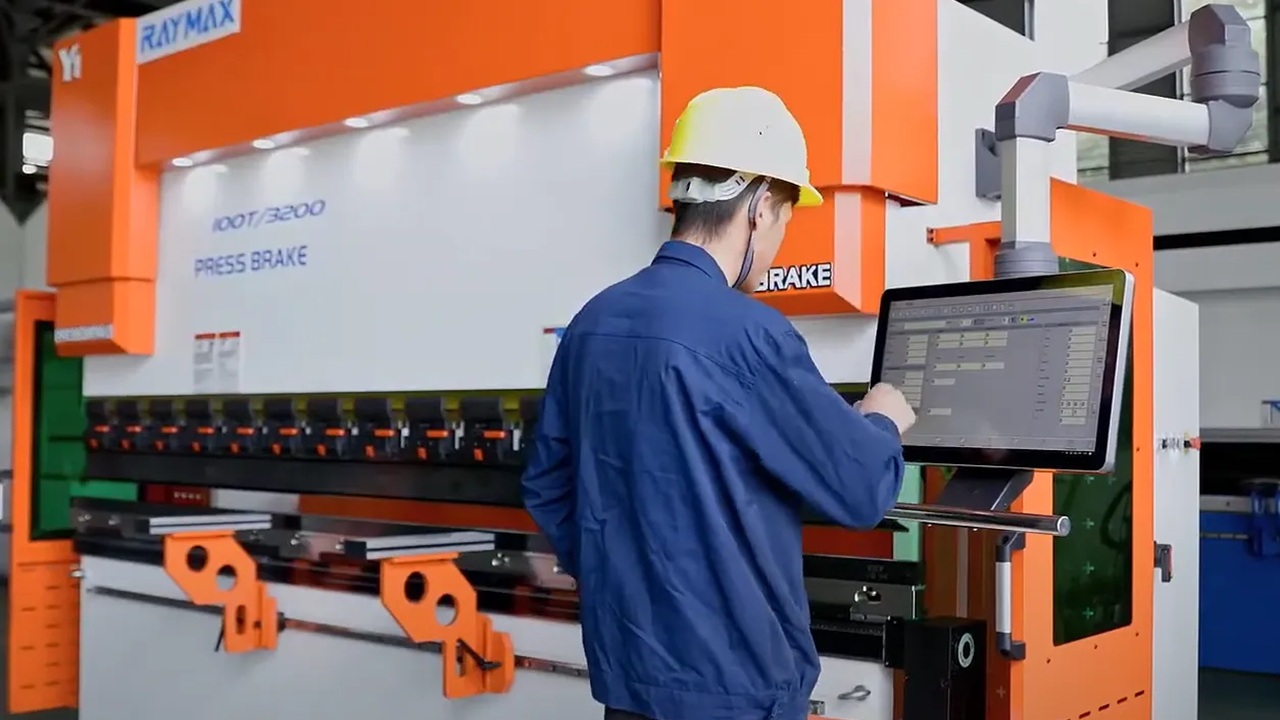
Long workpieces are often the most difficult parts to bend accurately on a press brake. Even when the bending program, tooling, and material are correct, angle inconsistency can still appear across the length of the part. One common reason is machine frame deformation. Under heavy bending force, the frame and worktable of the press brake experience slight elastic movement. This movement may be very small, but it can still affect the final bend angle, especially on long sheets. If frame deformation is not properly controlled or compensated, production quality gradually becomes unstable. Check out raymaxtech.com for more information on Raymax’s press brakes.
Why Frame Deformation Happens
Press brakes exert large forces during bending. When long or thick sheets are processed, this force is distributed across the machine structure. Even strong machine frames bend slightly under load. This is quite a natural effect and does not indicate any defects within the machine. However, if the degree of deformation is excessive or uneven, the accuracy of the bending suffers.
Long Parts Show Problems More Clearly
Small workpieces usually bend over a short area, so minor frame movement may go unnoticed. Long parts are different. Since the bending force acts over a wider area, the deformation can be easily detected. For example, the operators will see that the center angle is not equal to the angle on either edge.
Angle Variation Along the Bend Line
Frame distortion tends to occur to varying degrees along the length of the panel. Distortion in the middle may be greater than at the ends, or vice versa, depending on the weight applied and any modifications to the setup. This frequently occurs when bending large pieces of sheet metal, cabinet doors, cabinet frames, and other cabinet parts uniformly from both sides.
Material Thickness Increases the Effect
Thicker materials require greater bending force. As tonnage increases, machine deformation also becomes more noticeable. A setup that works well for thin sheet metal may produce angle inconsistency when heavier material is introduced. In systems such as those used on RAYMAX press brakes, compensation systems are often used to reduce this effect during high-load bending operations.
Uneven Load Distribution
The way a workpiece is positioned also affects frame behavior. If the bending force is concentrated more heavily on one side of the machine, deformation may become uneven. This can create different bend angles across the part or between repeated cycles. Operators sometimes mistake this issue for tooling wear or programming errors.
Crowning Compensation Matters
Most modern press brakes use some form of crowning compensation to reduce the effects of machine deflection. Slightly changing the angle will help to adjust the position of the work table or the tools to keep the pressure applied evenly on the sheet. However, if compensation settings are incorrect, the machine may still produce inconsistent results even when the frame itself is functioning normally.
Tooling Condition Also Plays a Role
Frame deformation problems can become worse when tooling is worn or improperly aligned. Uneven contact between the punch and die changes how force is distributed across the machine. This adds additional variation to the bending process. Sometimes operators focus solely on machine settings, ignoring tooling conditions as a contributing factor.
Temperature and Long Production Runs
Machine temperature can also influence deformation behavior during extended production cycles. After long periods of operation, hydraulic systems, tooling, and structural components warm up slightly. These small thermal changes may alter bending behavior enough to affect long-part consistency. This is why some parts measure differently at the end of a shift compared to the beginning.
Assembly Problems from Inconsistent Angles
Long parts with uneven bend angles often create assembly issues later. Panels may not align correctly, gaps may appear between sections, or welded assemblies may require force to fit together. These problems increase rework time and reduce production efficiency. In many cases, the root cause lies in uncontrolled machine deformation rather than operator error.
Regular Accuracy Checks Are Necessary
Testing the bend angle at the starting point alone does not always suffice when working on lengthy parts. In most cases, several tests must be performed throughout the length of the workpiece. This test will help determine if any deformation or compensation issues are impacting manufacturing. Manufacturers such as RAYMAX commonly recommend periodic accuracy checks to maintain stable long-part bending performance.
Machine Wear Can Increase Deformation
Over time, wear in machine components may increase overall movement under load. Machine guides, hydraulics, and connections become less stiff over time. While the machine may appear to be running normally, its ability to maintain consistent angles may be slowly diminishing. Regular maintenance helps reduce this long-term accuracy drift.
Conclusion
Deformation of the machine structure is inherent in press brake bending, particularly when bending long parts or large sections. However, machine structure deformation occurs when deformation is uneven or improperly adjusted, leading to variations in bending angle along the length of the part. Such problems usually arise over time, sometimes manifesting as assembly issues or requiring constant operator adjustments. By regularly monitoring machine health, tool setup, and compensation, companies can minimize the issue of long-part precision bending. Even with modern systems like RAYMAX press brakes, controlling deformation remains an important part of precision bending.